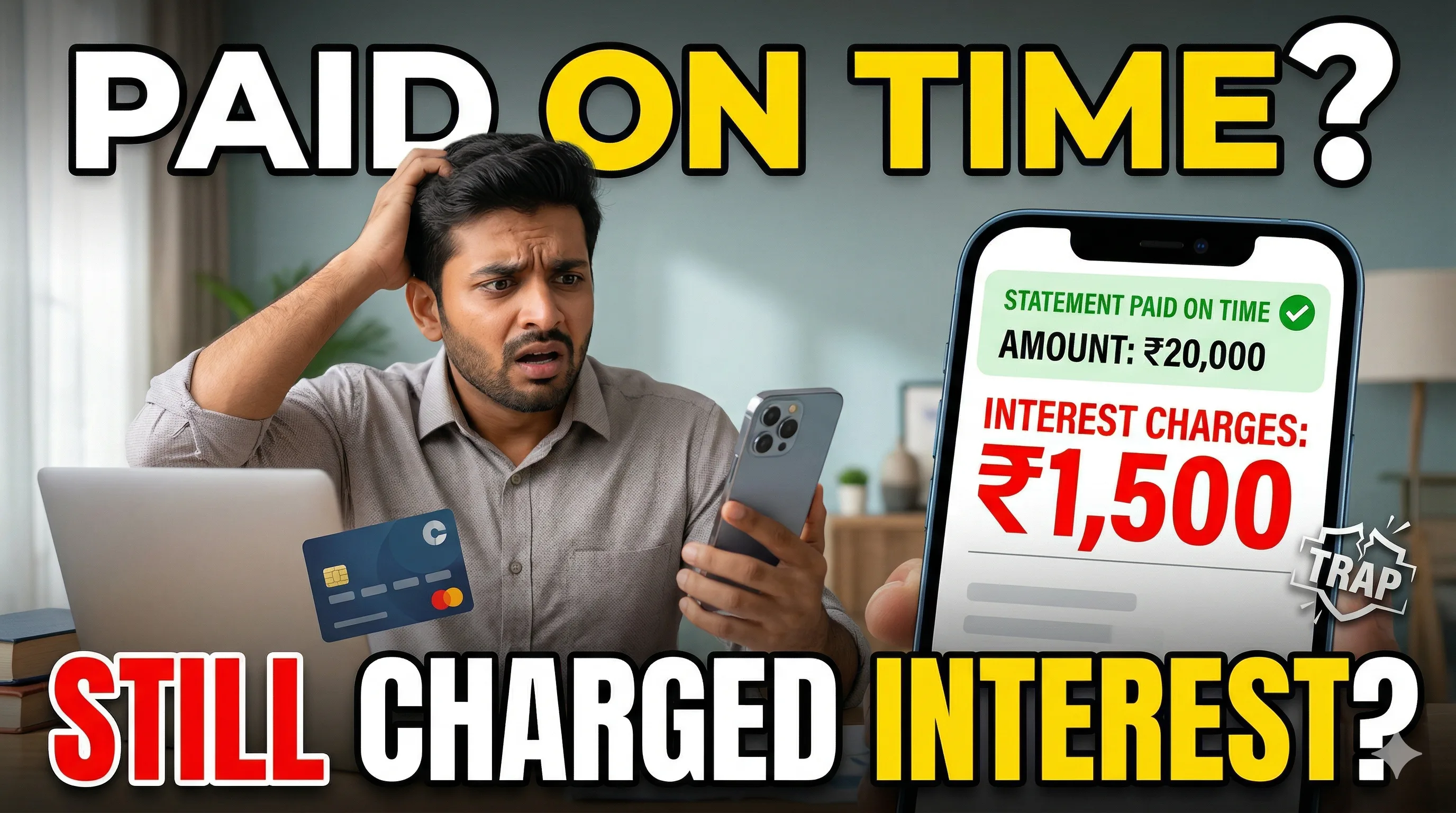
Why Did I Get Charged Interest on My Credit Card Even After Paying on Time?
You did everything right. You checked your mobile app, saw the due date, and made a payment. You might have even paid more than the minimum. Yet, when the next statement arrives, there is a giant "Finance Charge" staring back at you.
It feels like a betrayal. You ask yourself: "Is the bank cheating me? Did they miss my payment?"
⚡ Quick Summary
Key Takeaways: Confused why your Indian credit card statement shows interest even after paying on time? Discover the Minimum Due trap, how interest is calculated daily, and how to avoid hidden finance charges.
Short Answer (Featured Snippet): You were charged interest because you did not pay the Total Amount Due in full. In India, paying even ₹1 less than the full bill cancels your interest-free period. Consequently, the bank charges interest on your entire balance starting from the actual date of each transaction, not just from the due date.
1. The Minimum Due Trap: Why Banks Love It
When you get your bill, the bank highlights the "Minimum Amount Due" (usually 5% of the total). If you are a beginner with your first credit card, this looks like a great deal. You think, "I can just pay ₹1,000 now and pay the rest later!"
Here is what the bank doesn't tell you clearly: The Minimum Due is only to save you from a "Late Payment Fee" and to keep your card from being blocked. It does nothing to stop the interest. The moment you pay only the minimum, the remaining 95% of your bill starts growing like a monster.
2. The Loss of Your Interest-Free Period
Most Indian credit cards offer a 45 to 50-day interest-free period. This is a grace period where the bank lends you money for free. But this grace period is a conditional reward. The condition is that you must pay 100% of the bill.
If you carry forward even a tiny balance, the bank revokes this reward. This means:
Interest is backdated to the day you bought the item.
New purchases you make today will have zero grace period.
Stop Losing Money to Manual Mistakes
Tracking billing cycles across 3 different cards is hard. CreditPlanner does it for you automatically so you never miss a 'Total Due' payment again.
Let's look at how a small balance creates a large interest charge in India. Imagine you spent ₹20,000 on a new phone.
Description
Amount
Total Bill Generated
₹20,000
Amount You Paid (On Time)
₹2,000
Unpaid Balance Carried Forward
₹18,000
Interest Charged On
₹20,000 (The Full Initial Amount!)
Finance Charges (Approx. 3.5% p.m.)
₹700
18% GST on Interest
₹126
Total You Owe Next Month
₹18,826
Even though you paid ₹2,000, your debt only went down by about ₹1,174 because the rest was eaten by interest and taxes!
4. Understanding Interest Rates in India (2026)
Indian banks like HDFC, SBI, and ICICI generally charge between 3.25% to 3.80% per month. While this sounds small, it is actually 39% to 46% per year. This is 10 times more expensive than a home loan! If you are looking to compare credit cards, always look at the "APR" (Annual Percentage Rate) in the fine print.
5. How Banks Calculate Your Interest Daily
The bank uses a method called Average Daily Balance. Every night at 12:00 AM, the bank's computer looks at how much you owe. If you spent ₹10,000 on Day 1 and didn't pay it back until Day 30, you are charged interest for all 30 days. This is why paying "halfway through the month" is actually better than waiting for the due date if you cannot pay the full amount.
6. The Hidden Charges: GST and Late Fees
In India, "Finance Charges" aren't the only thing on your bill. You will also see 18% GST on every single fee the bank charges you. If you miss the due date entirely, you will also get a Late Payment Fee (usually ₹500 to ₹1,300), and guess what? There is 18% GST on that too!
7. Residual Interest: When Does the Billing Stop?
Many people say, "I paid the full bill this month, so why is there still interest on my next bill?" This is called Residual Interest. It is the interest that was building up between the day your bill was printed and the day you finally clicked "Pay." To stop this, you usually have to pay two full months of "Total Due" to reset the bank's system.
8. Visual Billing Cycle Timeline
Understanding the "Interest-Free" window is all about timing. Here is how it works in a typical 50-day cycle:
Day 01: You buy a ₹10,000 item. Interest "clock" is at zero.
Day 30: Statement is Generated. Total Due = ₹10,000.
Day 45: You pay only ₹1,000 (The Minimum).
Day 50: Due Date Passes.
Day 60: Next Statement. The bank charges interest on ₹10,000 for 45 days AND on ₹9,000 for 15 days.
9. Rahul's Story: A ₹500 Mistake that Cost ₹5,000
Rahul always paid his bills on time. One month, his bill was ₹50,500. By mistake, Rahul typed "₹50,000" in his banking app and forgot about the ₹500. He thought, "It's just ₹500, I'll pay it next month."
Because he left ₹500 unpaid, the bank cancelled his grace period for the entire ₹50,500. Next month, Rahul was shocked to see a bill for ₹2,800 in interest! His ₹500 mistake cost him 10 times more in finance charges. This is why checking your premium cards for exact amounts is vital.
10. Actionable Tips to Never Pay Interest Again
Always Pay the 'Total Amount Due': Never settle for the minimum. If you are short on cash, borrow from a friend or a low-interest personal loan—it's still cheaper than a credit card.
Set Auto-Debit: Set your bank account to automatically pay the Full Amount 3 days before the due date.
Avoid Cash Withdrawals: Withdrawing cash from an ATM has no interest-free period. Interest starts from the second the money leaves the machine.
Keep Utilization Below 30%: If your limit is ₹1 Lakh, don't spend more than ₹30,000. This makes it easier to pay the full bill every month.
11. Frequently Asked Questions
What happens if I pay only the minimum due?
You avoid late fees and CIBIL damage, but you will pay 36-48% interest on the rest of the bill. Your grace period is also lost for all future purchases.
Is credit card interest charged daily in India?
Yes. The bank calculates your "Average Daily Balance" and applies the monthly interest rate divided by 30 to each day you held the debt.
How can I avoid finance charges completely?
Pay 100% of the "Total Amount Due" before the due date every single month. No exceptions.
What is residual interest?
It is interest that accumulates between the statement date and your payment date. It often appears on the bill after you think you've cleared your debt.
Tired of Paying Interest to Banks?
Use CreditPlanner to visualize your billing cycles and get smart alerts on when to pay. Stop losing money and start earning rewards today.