The golden era of the Indian credit card is officially over.
If you feel like your "Premium" card is starting to feel a lot like a basic one, you aren’t imagining it. While you were sleeping, your bank likely sent a "small update" via SMS or a hidden PDF link in your email. Behind that corporate jargon was a simple message:
We are taking your rewards back.
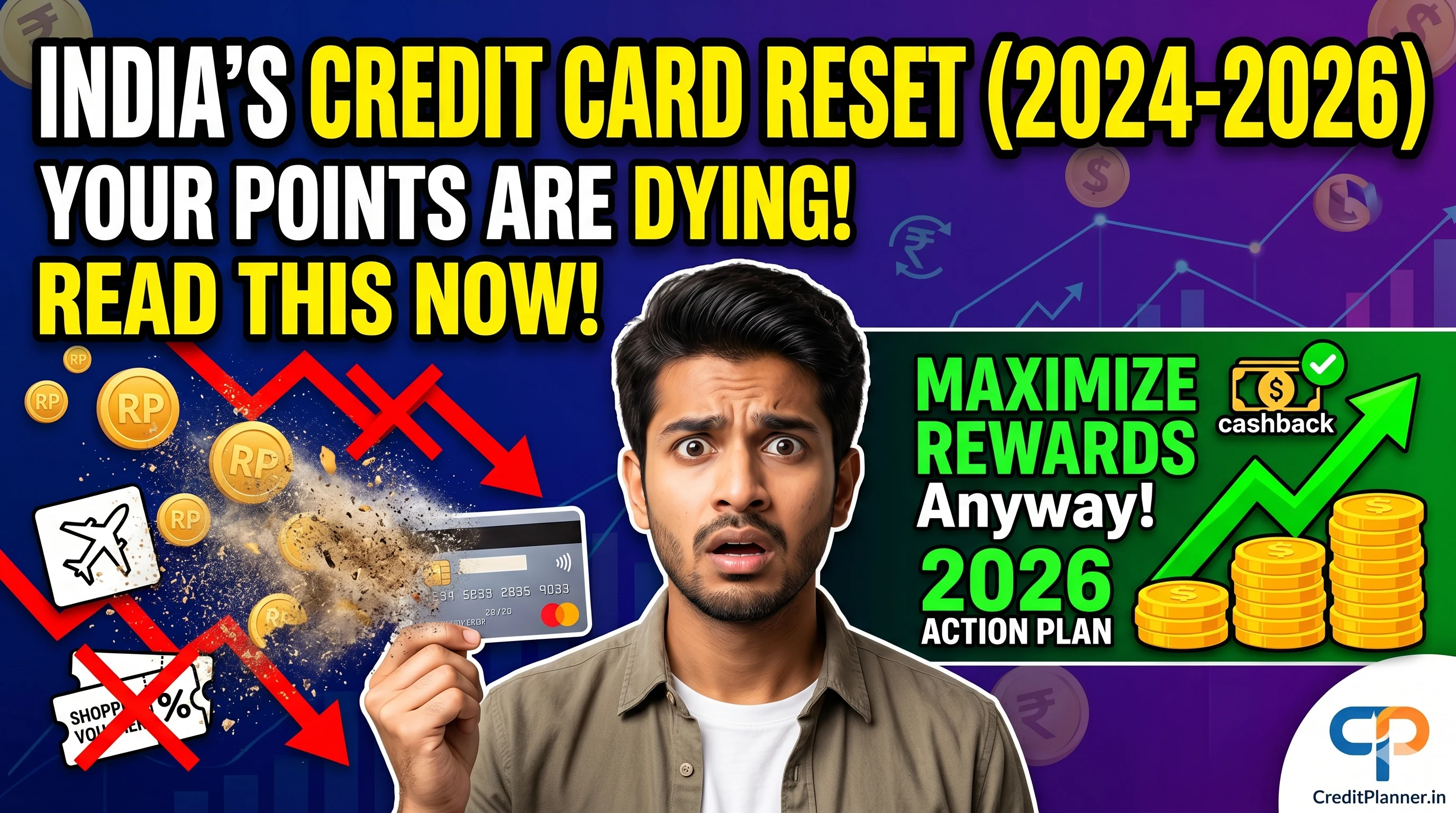
Between 2024 and 2026, the Indian credit card landscape has undergone a "Great Devaluation." What used to be a ₹1 reward is now often worth ₹0.20. Lounge access, once a given for anyone with a plastic card, is now a "privilege" reserved for those who spend more than some people earn in a year.
At CreditPlanner.in, we believe in being honest. The banks are no longer in a "customer acquisition" phase; they are in a "profitability" phase. And you, the user, are the one paying the price. In this guide, we’ll break down exactly how you’re being squeezed and, more importantly, how you can flip the script to still come out on top in 2026.
What Exactly is Credit Card Devaluation?
Think of devaluation like inflation, but for your wallet's plastic. In simple terms, credit card devaluation in India is when a bank reduces the value of the benefits it previously promised. This happens in three "silent" ways:
- The Points Squeeze: You used to get 5 points for every ₹100. Now you get 2.
- The Value Drop: You used to be able to buy a ₹500 Amazon voucher with 500 points. Now, you need 2,000 points for that same voucher.
- The Exclusion Game: The bank says, "Sure, we give rewards on everything... except rent, school fees, insurance, utilities, and wallet loads." (Spoiler: That’s basically half of your monthly budget).
A Relatable Example:
Imagine you have a card that offers 5% value back. In 2023, you spend ₹1,000 on a dinner and get ₹50 back. In 2026, you spend that same ₹1,000. However, the bank has added a "Redemption Fee" of ₹99 + GST. To get your ₹50 cashback, you actually have to pay the bank ₹117. Result: You literally lost money by using your rewards.
Recent Devaluation Trends in India (2024–2026)
If you haven't checked your card's Terms & Conditions (T&C) lately, brace yourself. The last 24 months have seen a bloodbath of benefits across HDFC, ICICI, and SBI.
1. The Lounge Access "Barrier"
Gone are the days when you could walk into a Delhi or Mumbai airport lounge just by flashing your card. Most banks have moved to a Spend-Linked Model.
- ICICI Bank: As of 2025/2026, many cards require a minimum spend of ₹75,000 in the previous quarter to unlock a single lounge visit in the current quarter.
- HDFC Bank: Even for premium variants like Regalia Gold, the spend thresholds have tightened. If you don't hit the quarterly target, you're paying ₹2,000+ for that buffet.
2. The "Rent & Utility" Massacre
For years, smart users paid their house rent via credit cards to hit "Milestone Targets." Banks caught on fast.
- Fees: Almost every major bank now charges a 1% fee on rent payments.
- Zero Rewards: Rent, utilities (electricity/water), and insurance premiums have been moved to the "Exclusion List" for many cards. You still pay the 1% fee, but you get 0 points.
3. Capping the "Uncapped"
The SBI Cashback Card was once the "King of Cashback" with 5% back on almost all online spends. In 2025-2026, this was capped strictly at ₹2,000 per month. For a high-spender, this effectively dropped the reward rate from 5% to less than 1% after the cap was hit.
Why Banks Are Doing This (The Bitter Truth)
You might be angry at your bank, but from their perspective, the party was too expensive. They are shifting their best credit card strategy in India from mass-market growth to niche profitability.
- Profitability Pressure: For years, banks used "VC-style" burning to acquire users. Now, they need to show profits to shareholders.
- The "Cred" Effect: Apps that made it easy to pay rent or load wallets led to "manufactured spending." People were moving money just to earn points without actually buying anything.
- Rising Reward Costs: As users became "smarter" (thanks to YouTube and blogs), they started maximizing every rupee. Banks realized they were losing money on the 1% of users who knew the "hacks."
Hidden Ways You’re Losing Money Right Now
Most users look at their "Points Balance" and feel rich. They are wrong. Here is where the value is leaking in terms of credit card hidden charges in India:
1. The Redemption Fee Trap
Most banks now charge a "Convenience Fee" of ₹99 to ₹250 + GST every time you redeem points. If you redeem a ₹500 voucher and pay ₹118 in fees, your actual reward is only ₹382.
2. Ignoring the "Net Reward Rate"
Don't listen to the 10x or 20x marketing. Calculate your Net Reward Rate (NRR) using this formula:
$$NRR = \frac{(\text{Total Value of Rewards}) - (\text{Redemption Fees} + \text{Annual Fees})}{\text{Total Spend}} \times 100$$
If your NRR is below 1.5%, your card is effectively a piece of plastic with a high ego.
How to Beat Devaluation (The Core Value Section)
You can't stop the banks from devaluing, but you can change how you play the game to maximize credit card rewards in India.
- Shift to "Pure Cashback" Cards: Points can be devalued overnight. Cashback is real money credited to your statement. Focus on: SBI Cashback, HDFC Swiggy, or SBI Cashback cards.
- Master the "Category Specific" Approach: Stop using one card for everything. Use the SBI Cashback ONLY for bills (25% back) and the HDFC Swiggy ONLY for food (10% back).
- The Milestone Hunter: Since base rewards are dying, the only way to get a 3–5% return is by hitting milestones (e.g., "Spend ₹1 Lakh in 90 days for a ₹2,000 voucher").
Smart Credit Card Strategy for 2026
If you are a beginner or an intermediate user in a Tier-2 city, don't overcomplicate things. You only need the "Holy Trinity" of cards:
| Card Type | Purpose | Recommendation (Examples) |
|---|---|---|
| The Core (Cashback) | Online shopping & daily spends | SBI Cashback or HDFC Swiggy |
| The Utility Card | Phone bills, Electricity, Recharges | SBI Cashback |
| The Backup (LTF) | For sales (Amazon/Flipkart) & offline | Amazon Pay ICICI (Lifetime Free) |
Find the Best Credit Card for You
Choosing the right credit card is only half the game. Using it correctly is where most people lose money.
That’s where CreditPlanner’s CardWise tool comes in.
- Know exactly which card to use today based on your billing cycle
- Avoid interest charges by tracking your payment and statement dates
- See “spend”, “avoid”, and “pay” zones for every card
- No bank login, no card number required — completely private
Why this matters: Most users don’t lose money because of bad cards — they lose money because they use the right card at the wrong time.
CardWise fixes that.
Red Flags Before Choosing a Credit Card
- Complex Tiers: If the reward system needs a PhD to understand, run.
- High Redemption Fees: Anything above ₹99 is a red flag.
- The "Lounge Access" Lie: If the card advertises "Complimentary Lounge Access" but hides a ₹50k spend per month requirement, it's not really complimentary.
Frequently Asked Questions (FAQ)
What is credit card devaluation?
It is the process where a bank reduces the value of reward points or removes benefits like lounge access and insurance coverage from a credit card.
Are credit cards still worth it in India?
Yes, but only if you use them for the interest-free period and targeted cashback. The "reward point" era is dying, but the "cashback" era is still strong.
Which cards give the best value after devaluation?
Currently, cashback-focused cards like the SBI Cashback Card, HDFC Swiggy are outperforming traditional reward-point cards for the average user.
How to maximize credit card rewards?
Use a multi-card strategy where each card is dedicated to a specific category (Fuel, Grocery, Utilities) rather than using one card for all expenses.
Why was lounge access removed?
Due to overcrowding and high costs, banks now only offer lounge access to users who meet specific quarterly spending targets.
Find the Best Credit Card for You
Confused which card to choose? Use our free tool to compare and maximize your rewards.
Compare Credit Cards NowFinal Thoughts: Be a "Smart" user, not a "Loyal" one. Your bank will devalue your card the moment it benefits their bottom line. Stay updated, track your spends, and never pay an annual fee for a card that doesn't pay you back at least triple that amount in value.
Sources & Methodology
To ensure accuracy, all insights in this article are based on official bank communications, financial reports, and industry analysis from 2024–2026.
1. HDFC Bank: Reward & Lounge Updates
- Base reward rate revisions for Regalia Gold, BizPower, and Diners Club cards (2026)
- Lounge access linked to ₹60,000 quarterly spend
- Tax payment reward caps and exclusions from accelerated reward thresholds
Source:HDFC Bank official customer notices (2026), SaveSage Report (April 2026)
2. SBI Card: Cashback & Fee Changes
- SBI Cashback Card monthly cap reduced to ₹2,000 (April 2026)
- Statement credit redemption limits and rules updated
- 1% fee introduced on high-value utility payments
Source: SBI Card Important Notices (Feb–April 2026)
3. ICICI Bank: Charges & Eligibility Updates
- Interest rates increased to 3.85% per month (46.2% annually)
- Rent, education, and government payments excluded from fee waiver calculations
- Lounge access linked to ₹75,000 quarterly spend
Source: ICICI Bank Features & Charges Notice (April 2026)
4. Axis Bank: Lounge Access Restrictions
- ₹50,000 spend requirement for lounge access across multiple cards
- Removal of lounge benefits from select co-branded cards
Source: Axis Bank Lounge Access Program Documents (2024–2025)
5. Industry-Wide Charges & Trends
- 1% fee on rent payments via third-party platforms (Cred, NoBroker, etc.)
- Education payment fees introduced for third-party platforms
- Standard redemption fee of ₹99 + GST across major banks
Source: Bank Schedule of Charges (2025–2026), PaytmFinancial news reports
6. Economic Context
- Rising household leverage and tighter lending norms
- Shift toward profitability-focused reward structures
Source: RBI Financial Stability Report (2025–2026), industry analysis
Note on Calculations
The Net Reward Rate (NRR) formula and spending examples used in this article are simplified financial models created by CreditPlanner to help users understand the real-world impact of fees, exclusions, and reward devaluation.